The kitchen sink is where dish piles grow, vegetables get prepped, and fingerprints somehow multiply overnight. Yet it’s often the worst-lit spot in the kitchen, a shadowy corner where you’re chopping onions under a dim overhead bulb. Good lighting at the sink isn’t a luxury: it’s a safety issue and a workflow upgrade. Whether you’re rinsing greens, scrubbing pans, or inspecting glassware for spots, proper task lighting makes the job faster and less frustrating. This guide walks through the most effective kitchen sink lighting solutions, from pendants that add personality to under-cabinet strips that disappear into the design.
Table of Contents
ToggleKey Takeaways
- Kitchen sink lighting ideas should prioritize task lighting at 300–500 lumens to eliminate shadows and reduce eye strain during food prep and dishwashing.
- Pendant lights mounted 30–36 inches above the sink offer the perfect balance of targeted illumination and style, making them the go-to fixture choice for most kitchens.
- Under-cabinet LED strips provide seamless, shadow-free lighting and work best when mounted as far forward as possible toward the counter edge for optimal visibility.
- Choose bulbs with a color temperature between 3000K–4000K and a CRI of 90+ to accurately render food colors and maintain a cohesive, professional lighting design.
- Dimmable LED bulbs paired with compatible dimmer switches give you flexibility to adjust brightness from focused task lighting during prep work to ambient evening light.
Why Kitchen Sink Lighting Matters More Than You Think
Most kitchens rely on a single ceiling fixture to light the entire room. That might work for walking through the space, but it fails when you’re hunched over the sink with your body casting a shadow on the basin. Task lighting at the sink eliminates those shadows and gives you clear visibility for detail work, spotting food debris on dishes, trimming stems, or reading prescription labels on bottles before rinsing.
Good sink lighting also reduces eye strain during repetitive tasks. If you’ve ever squinted to see whether that glass is actually clean or just looks clean, you know the difference a focused light source makes. Beyond function, the right fixture ties the sink area into the room’s overall design. A well-chosen pendant or under-cabinet strip can make the sink feel like an intentional focal point rather than an afterthought.
Consider the color temperature of your lighting, too. Bulbs in the 3000K to 4000K range (warm white to neutral white) render food and dishware accurately without the sterile feel of pure daylight bulbs. If your kitchen has warm wood tones, lean toward 3000K: for modern spaces with stainless and white cabinetry, 3500K–4000K works better.
Pendant Lights: The Perfect Balance of Task and Style
Pendants are the go-to solution when you want targeted light and visual impact. Hung 30 to 36 inches above the countertop (measure from the bottom of the fixture to the surface), they put light exactly where you need it without glaring in your eyes. For a standard 36-inch-wide sink, one centered pendant works: for a farmhouse or double-basin sink, two smaller pendants spaced evenly often look better.
Choose a shade that directs light downward, metal cones, glass domes, or drum shades with opaque tops. Clear glass globes look great but scatter light in all directions, which dilutes the task lighting effect. If the sink sits in front of a window, avoid overly large pendants that block the view. A compact 8- to 10-inch diameter fixture keeps sightlines open.
Wiring pendants usually means running cable through the ceiling, which can involve opening drywall if there isn’t existing electrical rough-in above the sink. If you’re comfortable working with electrical, turning off the breaker, using a voltage tester, and securing wire nuts, this is a manageable DIY task. Otherwise, hire a licensed electrician. Some jurisdictions require a permit for new fixture installations, especially if you’re adding a new circuit. Check local codes before you drill.
Many designers recommend choosing pendant lights with dimmable LED bulbs, allowing you to dial brightness up for scrubbing and down for ambient evening light.
Under-Cabinet Lighting for Seamless Illumination
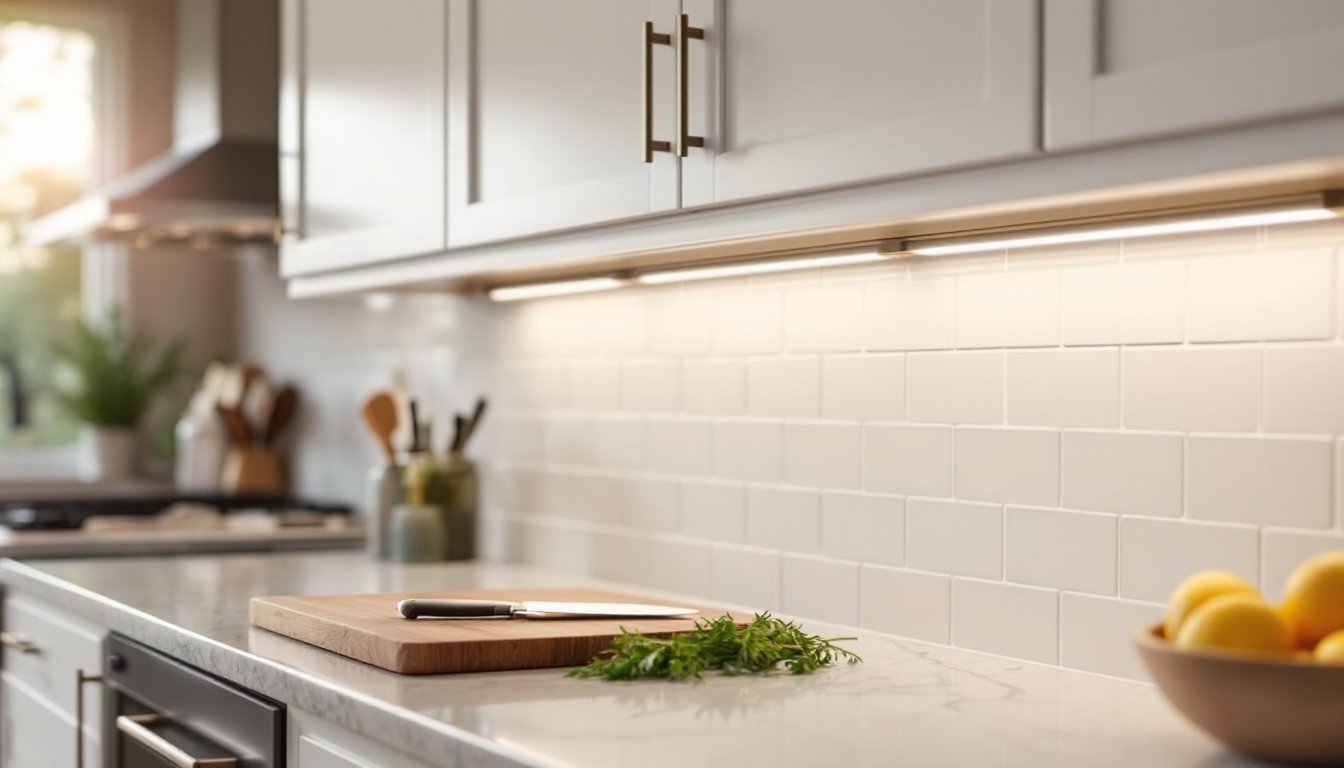
Under-cabinet lighting hides the source and floods the counter with even, shadow-free light. It’s ideal if you prefer a clean look without hanging fixtures, or if your cabinets sit directly over the sink. LED strip lights and puck lights are the two most common formats.
LED strips mount along the front edge of the cabinet bottom using adhesive backing or mounting clips. They produce a continuous line of light with no dark spots between fixtures. Look for strips rated for at least 300 lumens per foot for task lighting: anything less is decorative but won’t give you enough visibility for prep work. Hardwired strips require running 120V wiring inside the cabinet and connecting to a wall switch. Plug-in strips are easier to install, just route the cord to a nearby outlet and use a wireless remote or in-line switch.
Puck lights are small, round fixtures spaced every 8 to 12 inches under the cabinet. They create pools of light rather than a continuous wash, which some people prefer for a less uniform look. Battery-powered pucks are the easiest install, peel, stick, done, but expect to replace batteries every few months with regular use. Hardwired or plug-in pucks last longer and stay brighter.
Mount under-cabinet fixtures as far forward (toward the counter edge) as possible to minimize shadows from your hands and cutting boards. If the cabinet has a face frame, mount the strip just behind it so the LED isn’t visible from a standing position. For frameless European-style cabinets, use an aluminum channel with a frosted diffuser to hide individual LED dots and create a smooth light line.
One advantage of inside cabinet lighting solutions is they can extend into glass-front cabinets, adding ambient glow and highlighting dishware.
Recessed Lighting for a Clean, Modern Look
Recessed cans (also called downlights or pot lights) sit flush with the ceiling, making them nearly invisible. They work best in kitchens with at least 8 feet of ceiling height: in lower ceilings, the light angle becomes too steep and you end up lighting the top of your head instead of the sink.
For sink task lighting, install one or two 4-inch or 6-inch recessed cans directly over the basin, positioned 18 to 24 inches out from the wall (not right against it, which would light the backsplash but miss the sink). Use a narrow flood beam (25–35 degrees) to concentrate light downward. Wide flood beams spread light too thin for effective task work.
Retrofit LED recessed kits make installation easier if you already have cans in place, just unscrew the old bulb and trim, plug in the new LED module, and snap the trim into the existing housing. If you’re cutting new holes, you’ll need IC-rated housings if there’s insulation in the ceiling cavity (common in top-floor kitchens or vaulted ceilings). Non-IC housings must have a 3-inch clearance from insulation, which can create cold spots.
Recessed lighting is a cleaner look than pendants, but it’s also less flexible. Once the cans are installed, you can’t easily move them. If you remodel and shift the sink location, the lights stay put unless you’re willing to patch drywall and repaint. Pendants, by comparison, can be moved by re-routing the cable.
Some homeowners pair recessed cans with flush mount fixtures elsewhere in the kitchen to maintain a cohesive, low-profile aesthetic.
Track Lighting: Flexible and Functional Solutions
Track lighting mounts to the ceiling and holds multiple adjustable heads along a rail, letting you aim light wherever it’s needed. It’s particularly useful in kitchens where the sink isn’t centered under a ceiling joist, or where you want to light both the sink and adjacent counter space with one fixture.
A 3- to 4-foot track positioned parallel to the counter edge, about 24 to 30 inches out from the wall, can hold two or three heads: one aimed at the sink, one at the prep area, and one at the dish rack. Look for heads with PAR20 or BR30 bulbs for focused task lighting. Decorative globe heads look good but throw light everywhere, which defeats the purpose.
Track systems come in single-circuit (all heads turn on/off together) and multi-circuit (heads can be grouped and switched separately). Multi-circuit tracks cost more but give you better control, run just the sink light during cleanup, or all heads when prepping a big meal.
Installation is similar to a ceiling fixture: turn off power, mount the track to a junction box or directly to ceiling joists (depending on the model), connect the wiring, and snap the heads into the track. Most tracks are surface-mounted, meaning you don’t need to cut into the ceiling. If the existing junction box isn’t where you want the track, you can use a track power feed that lets you offset the electrical connection from the track itself.
One downside: track lighting reads as utilitarian or commercial if not styled carefully. Pair it with modern or industrial decor rather than traditional or farmhouse kitchens, where pendants usually feel more at home. For ideas on blending styles of lighting in one space, consider how task and ambient fixtures complement each other.
Choosing the Right Bulbs and Brightness Levels
The fixture is only half the equation, the bulb determines how well you actually see. For sink task lighting, aim for 300 to 500 lumens per fixture. A single pendant over a small sink can hit that with one 60W-equivalent LED: under-cabinet strips might need 2 to 3 feet of strip at 300 lumens per foot to reach the same level.
Color Rendering Index (CRI) matters if you do any food prep at the sink. Bulbs with a CRI of 90 or higher show colors accurately, which helps when you’re checking produce for blemishes or sorting recycling. Cheap LEDs with CRI below 80 can make everything look washed out or shift reds toward orange.
Stick with LED bulbs for task lighting. They run cool (important under cabinets, where halogen bulbs used to create fire hazards), last 15,000 to 25,000 hours, and use a fraction of the energy. Avoid “daylight” bulbs rated 5000K or higher unless you want that clinical, blue-tinged light, most people find them harsh for residential kitchens.
Dimming capability adds versatility. Not all LEDs dim smoothly: check the bulb packaging for “dimmable” labeling and pair with a compatible LED dimmer switch. Older rotary dimmers designed for incandescent bulbs can cause LEDs to flicker or buzz. If you’re installing new switches, use a CL-rated or ELV dimmer designed for LED and CFL loads.
For pendant fixtures, use bulbs with the correct base type, E26 (standard medium base) is most common, but some pendants take E12 (candelabra) or GU10 (twist-and-lock). Check the socket before you buy bulbs. According to The Kitchn, pairing the right bulb with intentional fixture placement transforms even the most outdated kitchen into a functional workspace.
If you’re mixing fixture types, say, pendants at the sink and recessed cans elsewhere, match the color temperature across all bulbs so the lighting feels cohesive. A kitchen with 3000K pendants and 4000K recessed lights will look disjointed.
Conclusion
Lighting the kitchen sink well doesn’t require a full remodel, it just takes the right fixture in the right spot with the right bulb. Whether you hang a pair of pendants, tuck LED strips under the cabinets, or aim a recessed can downward, good task lighting makes every sink chore faster and less frustrating. Measure twice, check your electrical, and don’t skip the dimmer switch. Your hands, and your eyes, will thank you.