Recessed lighting has become the go-to solution for kitchens that need clean, modern illumination without sacrificing headroom or style. Also known as can lighting in kitchen applications, these flush-mounted fixtures disappear into the ceiling while delivering powerful, targeted light exactly where you need it, over countertops, islands, and prep zones. Whether you’re gutting a kitchen down to the studs or retrofitting an existing space, understanding the planning, product selection, and installation realities will save you time, money, and the frustration of poorly lit work surfaces.
Table of Contents
ToggleKey Takeaways
- Kitchen recessed lighting eliminates visual clutter and delivers targeted task illumination over countertops and islands without consuming wall space or competing with cabinetry.
- Proper placement is critical: position task lights 18 to 24 inches from walls and space cans 24 to 30 inches apart to illuminate work surfaces rather than cabinet doors.
- Choose IC-rated (Insulation Contact) housings and airtight (AT) models to meet code requirements, prevent fire hazards, and improve energy efficiency in most modern kitchens.
- LED retrofit kits offer cost-effective upgrades to existing housings, while integrated LED modules provide superior thermal management and longer lifespan despite higher upfront costs.
- DIY installation is feasible for retrofit cans with attic access and existing circuit capacity, but hire a licensed electrician for new circuits, outdated wiring systems, or when local code requires professional work.
- Avoid common mistakes like ignoring beam angles, mixing color temperatures, and skipping junction box connections—careful planning and permit compliance ensure safe, compliant, and visually cohesive lighting design.
Why Recessed Lighting Is Perfect for Modern Kitchens
Recessed lights solve several problems at once. They eliminate the visual clutter of pendant chains and hanging fixtures, giving low ceilings a more open feel. They’re ideal for task lighting, focused beams that illuminate countertops, sinks, and stovetops without shadows. And because they’re sealed into the ceiling, they’re easy to clean in a room where grease and steam are constant.
Unlike surface-mounted fixtures, recessed cans integrate with nearly any design style. A farmhouse kitchen and a minimalist loft can both use the same housing: you’re just swapping the trim style and bulb temperature. That flexibility extends to retrofits, too. If you’ve got access to the ceiling from above (attic or crawl space), adding recessed lights is straightforward. Even with no attic access, remodel housings let you cut holes and clamp fixtures directly to drywall.
One practical advantage: recessed lighting doesn’t compete for space with cabinetry, range hoods, or tall appliances. In a room where every inch of wall and ceiling real estate counts, that’s a big win. Plus, modern LED retrofits mean you can upgrade old incandescent cans to energy-efficient, long-life LEDs without touching the housing.
Planning Your Kitchen Recessed Lighting Layout
Start with a lighting plan that layers ambient, task, and accent light. Recessed cans can handle all three roles, but placement is everything. Ambient lighting fills the room with general illumination. Task lighting targets work zones. Accent lighting highlights architectural features or open shelving.
Draw your kitchen to scale, marking cabinets, appliances, and the island. Identify your primary work surfaces: the sink, range, and main prep counters. These zones need the most light. Ambient coverage comes from spacing cans evenly across the ceiling: task lighting requires fixtures positioned directly over (or slightly in front of) work areas to minimize shadows.
A common DIY mistake is centering cans in the room without considering cabinet depth. Upper cabinets typically project 12 to 15 inches from the wall. If you center a can between the wall and the room’s midpoint, you’ll light the cabinet faces instead of the counter. Position task lights about 18 to 24 inches out from the wall to cast light onto the counter surface, not the cabinet doors.
For island lighting, cans should sit directly above the countertop perimeter, not over seating areas (unless you want to spotlight your guests’ heads). If your island doubles as a dining or assignments zone, consider adding dimmers or a separate circuit so you can dial down task lighting during non-prep hours.
Spacing and Placement Guidelines
General ambient spacing: Divide the ceiling height by two. For an 8-foot ceiling, space cans roughly 4 feet apart. For a 9-foot ceiling, go 4.5 feet. This rule of thumb prevents dark spots and overlapping hotspots.
Task lighting spacing: Over continuous counters, place cans 24 to 30 inches apart and 18 to 24 inches from the wall. Over islands, use the same 24- to 30-inch spacing along the long axis. If your island is narrow (under 36 inches wide), a single row down the center works. Wider islands may benefit from two parallel rows.
Trim size and beam spread: Standard residential cans are 4-inch or 6-inch diameter. Larger trims (6-inch) with wide flood bulbs provide better ambient coverage. Smaller trims (4-inch) with narrow spot bulbs are ideal for targeted task lighting. Many modern LED retrofit kits offer adjustable beam angles, so you can fine-tune spread after installation.
Dimming and control: Plan for dimmer switches on every circuit. LED-compatible dimmers (look for models rated for 0–10V or ELV loads) let you adjust light levels for cooking, dining, or late-night snacking. If you’re running new circuits, consider splitting ambient and task lights onto separate switches for maximum flexibility.
Always check your local electrical code. Most jurisdictions require kitchen lighting circuits to be on 15- or 20-amp breakers and may have rules about spacing, box types, and AFCI protection.
Choosing the Right Recessed Lights for Your Kitchen
You’ll choose two main components: the housing (the can that mounts in the ceiling) and the trim (the visible ring and lens). If you’re retrofitting or using newer construction, those choices diverge.
New construction (NC) housings are designed for installation before drywall goes up. They have adjustable bars that nail or screw directly to ceiling joists. Use NC cans if you’re building an addition, finishing a basement, or doing a full kitchen gut. They provide the most secure mounting and best access for running wire.
Remodel (old-work) housings install through a hole cut in existing drywall. Spring clips or twist-lock tabs grab the back of the drywall to hold the can in place. They’re the right call if your kitchen ceiling is staying put and you’re just adding lights. These cans are shallower than NC models, which helps in tight ceiling cavities, but they’re also harder to secure if you’re working around insulation or ductwork.
IC-rated vs. non-IC: IC (Insulation Contact) housings are required when insulation touches the fixture. Most modern homes have insulation in the ceiling cavity, so unless you’re certain your joists are clear, buy IC-rated cans. Non-IC housings must have at least 3 inches of clearance from insulation, which often isn’t realistic. IC-rated fixtures cost a few dollars more but prevent code violations and fire hazards.
Airtight (AT) housings: If you live in a cold climate or care about energy efficiency, choose housings rated airtight. Standard cans leak conditioned air into the attic, wasting energy and creating moisture problems. AT-rated cans have gasketed seals that block airflow. Many are also IC-rated (look for “IC-AT” on the label).
LED retrofit kits vs. integrated LED cans: You can buy a traditional housing and screw in an LED bulb, or you can buy an integrated LED module that replaces the entire trim-and-bulb assembly. Retrofit kits (often around $10 to $20 each) let you reuse existing housings and swap out old incandescent or CFL bulbs for LEDs. Integrated modules (around $15 to $35) offer better thermal management, longer lifespan (often 50,000+ hours), and cleaner aesthetics with no visible bulb socket. The trade-off: when the LED dies, you replace the whole module, not just a bulb.
Color temperature: Kitchens generally look best with 2700K to 3000K (warm white) for a cozy feel, or 3500K to 4000K (neutral to cool white) for a crisp, commercial-kitchen vibe. Install samples of different temperatures before committing to a dozen fixtures. What looks great in the showroom can feel clinical or dingy once it’s bouncing off your backsplash and cabinetry.
Lumens and wattage: An LED can producing 650 to 850 lumens is roughly equivalent to a 65-watt incandescent. For ambient lighting, aim for 50 to 75 lumens per square foot. A 120-square-foot kitchen needs about 6,000 to 9,000 total lumens, which breaks down to roughly eight to twelve 700-lumen cans depending on spacing and trim choice.
Installing Recessed Lighting: DIY vs. Professional Help
Running new electrical circuits and cutting holes in your ceiling sits at the intersection of carpentry and electrical work. If you’ve wired outlets or switches before, installing remodel cans is within reach. If you’ve never opened a breaker panel or fished wire through walls, hire a licensed electrician for at least the rough-in.
Permit requirements: Most jurisdictions require an electrical permit for new circuits or adding fixtures to existing circuits. Inspectors will check box fill calculations, wire gauge, breaker sizing, and proper grounding. Skipping the permit is risky, unpermitted work can complicate home sales and void insurance claims if something goes wrong. Many experienced DIY experts still follow proven installation methods and keep inspectors in the loop.
DIY-friendly scenarios:
- Retrofitting cans into an existing ceiling with attic access above
- Tapping into a nearby junction box with available capacity on a 15- or 20-amp circuit
- Installing LED retrofit kits into old, working housings
Call a pro if:
- Your panel is full and you need a new circuit (requires load calculations and breaker installation)
- You’re working with aluminum wiring, knob-and-tube, or other outdated systems
- Your ceiling has no attic access and you’re routing wire through finished spaces
- Local code mandates licensed work for any alterations to lighting circuits
Step-by-step for remodel cans (DIY with existing circuit capacity):
- Kill power at the breaker and verify with a non-contact voltage tester.
- Locate joists with a stud finder. Mark your can locations, ensuring they fall between joists and avoiding any ductwork, plumbing, or structural members.
- Cut holes using a hole saw sized to your housing template (typically 4 inches or 6 inches). Drill slowly to avoid splintering drywall or hitting hidden obstacles.
- Fish wire from the switch box to each can location. Use flexible 14/2 or 12/2 NM cable (12-gauge for 20-amp circuits, 14-gauge for 15-amp). Leave at least 18 inches of wire hanging out of each hole.
- Connect housings to the wire using wire nuts (black to black, white to white, ground to ground). Push the housing into the ceiling and engage the spring clips or mounting tabs until the trim flange sits flush.
- Install trims and bulbs (or retrofit modules). Restore power and test each fixture.
Common tools needed: hole saw or adjustable recessed light cutter, voltage tester, wire strippers, fish tape or flexible drill bit, ladder, drywall saw, and a headlamp (attics are dark).
Safety gear: Cut-resistant gloves (for metal housings with sharp edges), safety glasses (drywall dust and ceiling debris), and a dust mask if working in insulation. If you’re in an attic during summer, bring water and take breaks, heat exhaustion is real.
Average professional installation cost runs $200 to $250 per fixture including materials, labor, and permits. If you’re adding six to eight cans, budget $1,200 to $2,000. DIY materials (housings, wire, connectors, switches) typically cost $25 to $50 per fixture, but you’re investing your own time and assuming responsibility for code compliance.
Common Mistakes to Avoid with Kitchen Recessed Lighting
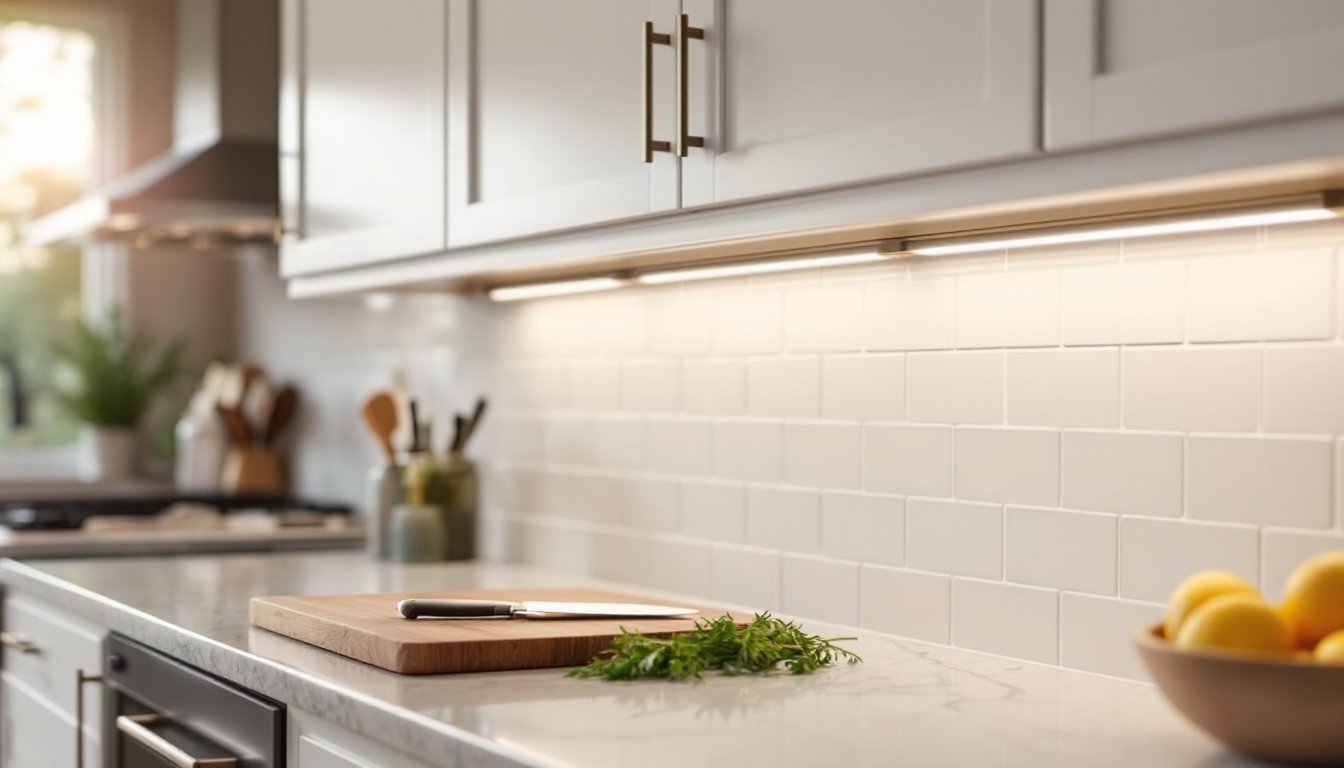
Overlighting or underlighting: More cans don’t automatically mean better light. Too many fixtures create glare and hot spots: too few leave dark corners. Stick to the spacing formulas and layer in under-cabinet task lighting or flush-mount fixtures for balance.
Ignoring beam angles: A narrow 25-degree spot is great for highlighting a backsplash but terrible for ambient fill. A wide 60-degree flood washes the ceiling with light but won’t punch through to the counter. Match beam angle to function.
Using non-IC cans with insulation: If an inspector finds a non-IC housing buried in fiberglass batts, you’ll be cutting holes and replacing fixtures. Always verify IC rating before closing up the ceiling.
Forgetting dimmer compatibility: Not all LED bulbs and retrofit kits play nice with standard dimmers. Look for “dimmable” on the packaging and pair with an LED-compatible dimmer. Flickering, buzzing, or limited dimming range are signs of a mismatch.
Poor spacing relative to cabinets: Cans installed too close to the wall light up cabinet doors: too far out and you lose task coverage. Measure carefully and mock up positions with painter’s tape before cutting.
Skipping junction box connections: Every splice must happen inside a listed junction box or the fixture’s integral box. Wire-nutted connections floating loose in the ceiling are a code violation and fire risk.
Mixing color temperatures: If you’re adding cans to a kitchen with existing fixtures, match the Kelvin rating. A mix of 2700K and 4000K looks unintentional and distracting.
Principles used in living room layouts apply here too: symmetry, balance, and respect for furniture (or in this case, cabinetry) placement all matter. And just as you’d carefully position lights in a living room, kitchens demand thoughtful planning around work zones rather than pure aesthetics. Even dining room lighting concepts remind us that dimmers and layered sources create flexibility for different moods and tasks.
Conclusion
Done right, recessed lighting transforms a kitchen from dim and dated to sharp and functional. Measure twice, follow code, and don’t skimp on quality housings or LEDs. If the project scope or permit requirements feel beyond your skill set, there’s no shame in hiring an electrician for rough-in and doing the trim installation yourself. The result, bright, shadow-free counters and a ceiling that doesn’t scream “1990s builder grade”, is worth the effort.