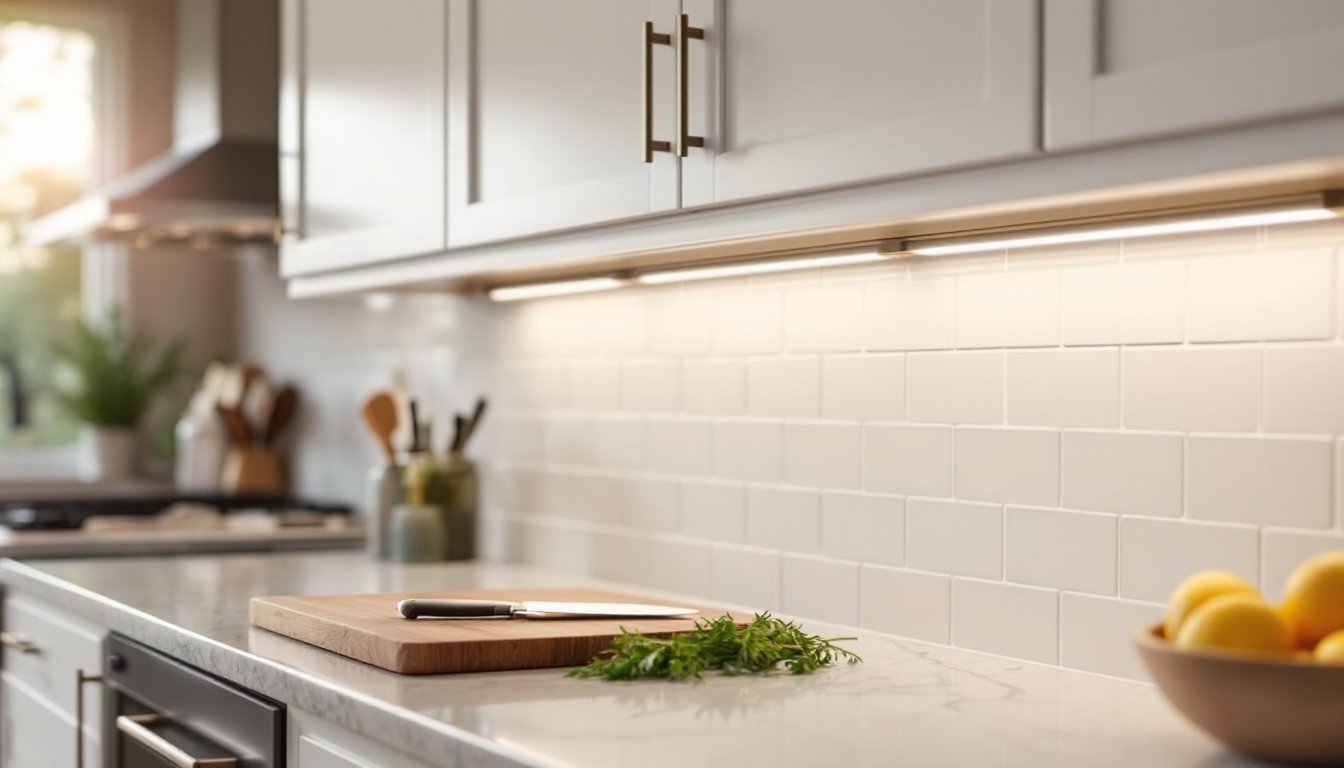
Under cabinet lighting can make or break a kitchen‘s functionality. But if you’re working with tight clearance, maybe 3 inches or less between your counter and the bottom of your wall cabinets, bulky fixtures aren’t an option. That’s where slim under cabinet lighting comes in. These low-profile fixtures deliver task lighting without eating up vertical space, and they’ve gotten good enough that you don’t sacrifice brightness or quality for the compact form factor. Whether you’re retrofitting an existing kitchen or planning a new build, the right slim lighting setup turns shadowy countertops into well-lit workspace.
Table of Contents
ToggleKey Takeaways
- Slim under cabinet lighting with profiles under 1 inch thick solves tight clearance challenges while delivering bright, efficient LED task lighting for kitchen countertops.
- Choose between LED strip lights for seamless coverage, puck lights for modular flexibility, or linear bars for a balanced approach—each type offers hardwired, plug-in, or battery-powered installation options.
- Aim for 200 to 400 lumens per linear foot of counter, select a color temperature between 2700K and 4000K depending on your kitchen style, and verify CRI 80+ for accurate color rendering.
- Proper placement 2 to 4 inches from the cabinet front edge and mounting in aluminum channels with diffusers minimizes shadows and prevents visible LED hotspots for professional results.
- Plug-in setups offer DIY simplicity, while hardwired installations provide cleaner aesthetics—hybrid low-voltage options deliver both switch control and minimal wiring complexity.
- Quality LED fixtures rated at 100+ lumens per watt with 25,000+ hour lifespans, motion sensors, and smart controls maximize energy efficiency while reducing maintenance and electricity costs.
What Is Slim Under Cabinet Lighting and Why Choose It?
Slim under cabinet lighting refers to fixtures with a profile typically under 1 inch thick, sometimes as thin as 1/4 inch. These use LED technology to pack serious lumens into a minimal footprint. The appeal is straightforward: they fit where standard puck lights or fluorescent strips won’t, and they stay out of sight when you’re looking straight at your cabinets.
You’d choose slim lighting for a few practical reasons. First, clearance. If your backsplash tile comes up high or your cabinets sit low, every fraction of an inch matters. Second, aesthetics. A slim fixture mounted to the underside of a cabinet is nearly invisible from most sightlines, no chunky housing or visible hardware. Third, retrofits. If you’re adding lighting to an existing kitchen without tearing into walls, a slim plug-in or battery-powered unit slips in with minimal fuss.
These fixtures work best as task lighting, illuminating counters for food prep, reading recipes, or spotting that errant coffee spill. They’re not meant to replace your overhead or flush mount fixtures for ambient light, but they complement them perfectly.
Types of Slim Under Cabinet Lighting Solutions
Not all slim lighting is created equal. The form factor dictates installation ease, light distribution, and how the fixture integrates with your kitchen layout. Here’s what’s out there.
LED Strip Lights vs. Puck Lights vs. Linear Bars
LED strip lights (also called tape lights) are the thinnest option, often 1/4 inch thick or less. They come on an adhesive-backed flexible strip, typically sold in 16-foot reels that you cut to length at marked intervals (usually every 2 or 4 inches). Strips give you continuous, even illumination with no dark spots. They’re ideal if you want seamless light across a long counter run. Downside: quality varies wildly. Cheap strips can have visible LED hotspots or inconsistent color temperature. Look for high-density strips (at least 60 LEDs per meter) with a diffuser channel (an aluminum extrusion with a frosted lens) to smooth out the light.
Puck lights are small, round (or square) fixtures about 3 inches in diameter. Slim puck lights usually measure around 3/4 inch thick. They’re modular, you install them in a series, spacing them every 12 to 18 inches. Pucks create pools of light rather than a continuous wash, which can look intentional or patchy depending on spacing. They’re easier to install than strips if you’re not comfortable cutting and connecting tape, and many come as battery-powered or plug-in kits with a puck-to-puck linking cable. Some recent under-cabinet lighting kits feature pucks with motion sensors built in, handy for midnight snack runs.
Linear bar lights split the difference. These are rigid fixtures, usually 12 to 48 inches long and about 1/2 to 3/4 inch thick. They mount end-to-end or with small gaps, giving you more control over coverage than strips but a cleaner look than pucks. Many bars are linkable, you connect them with short jumper cables, powered by a single driver or transformer. Bars are a solid middle ground: easier to install than tape, smoother light than pucks, and they often come with mounting clips or magnetic backs for quick attachment.
All three types are available in hardwired, plug-in, and battery-powered versions. Your choice depends on how permanent you want the install and whether you’ve got an outlet nearby.
How to Choose the Right Slim Under Cabinet Lighting for Your Kitchen
Start with lumens, not watts. LEDs are efficient, so wattage doesn’t tell you much about brightness. For task lighting, aim for 200 to 400 lumens per linear foot of counter. A 24-inch section of counter should get roughly 400 to 800 lumens total. Under-light and you’re squinting at your cutting board: over-light and it’s like prepping dinner in an interrogation room.
Color temperature matters more than most DIYers expect. Measured in Kelvin (K), it controls the warmth or coolness of the light. 2700K to 3000K is warm white, soft, yellowish, closer to incandescent bulbs. 3500K to 4000K is neutral white, crisper, good for task work. 5000K and up is daylight or cool white, very bright and blue-toned, which some find harsh in a kitchen. If your kitchen has warm-toned wood cabinets or a cozy vibe, stick to 2700K to 3000K. Modern or industrial kitchens can handle 3500K to 4000K. Many fixtures now offer tunable white or RGB options, letting you adjust color on the fly via a remote or app.
Dimmability is a must if you want flexibility. Not all LED fixtures dim smoothly, some flicker or drop out at low levels. Check the product specs for compatibility with standard TRIAC or ELV dimmers. If you’re going hardwired, match your dimmer to the fixture’s driver. Plug-in and battery units often include a built-in dimmer on the fixture or remote.
Power supply location dictates how clean your install looks. Hardwired setups hide the driver inside a cabinet or in the wall, but they require running 120V or low-voltage (12V or 24V) wiring, which may need a permit and possibly an electrician. Plug-in models need an outlet within a few feet, sometimes you can add an outlet inside a cabinet (check local code: inside-cabinet outlets typically require AFCI protection per NEC 210.12). Battery-powered units are the easiest install but need AA or rechargeable batteries swapped or charged every few weeks to months, depending on use.
CRI (Color Rendering Index) is another spec worth checking. CRI measures how accurately colors appear under the light, on a scale of 0 to 100. Sunlight is 100. For a kitchen, look for CRI 80 or higher: pro-grade task lighting hits CRI 90+. This is especially important if you’re a serious cook or baker, low-CRI lighting can make reds look muddy and greens look gray.
Installation Tips for Slim Under Cabinet Lighting
Prep work makes or breaks this install. Before you buy anything, measure the underside of your cabinets. Note any obstructions: mounting rails, supports, or uneven surfaces. Clean the mounting surface with isopropyl alcohol, grease and dust kill adhesive.
Placement is critical. Mount the fixture as far forward (toward the front edge of the cabinet) as possible without it being visible from normal standing height. This minimizes shadows cast by items on the counter. A good rule of thumb: 2 to 4 inches back from the front edge. If your cabinets have a face frame (the front rail), mount just behind it. Frameless (European-style) cabinets give you a bit more flexibility.
For LED strips, use an aluminum channel with a diffuser. It hides the individual diodes, protects the strip, and acts as a heatsink. Cut the channel to length with a hacksaw or miter saw, mount it with the included clips or adhesive, then press the strip into the channel. Route the power wire neatly, use cable clips or adhesive-backed channels along the inside edge of the cabinet to keep it tidy. If you’re linking multiple strips, pay attention to polarity (+ and – markings). Reversing polarity won’t damage most LEDs, but they won’t light up.
For puck or linear bar lights, mark your mounting points with a pencil and level. If using screws, pre-drill pilot holes to avoid splitting thin cabinet material (usually 1/2-inch plywood or particleboard). Some slim bars use magnetic mounts or twist-lock clips, these make future removal or repositioning easy.
Hardwired vs. Plug-In: Which Is Right for Your DIY Project?
Plug-in is the DIY-friendly option. You’ll need an outlet, either existing or newly installed. Many kitchens have outlets along the backsplash every 4 feet per code (NEC 210.52(C)), so you might already have one close. Run the cord along the back or side of the cabinet, secured with clips. Some kits include an inline switch or remote: others rely on a wall switch controlling the outlet. Plug-in setups take minutes to install and require zero electrical knowledge beyond plugging something in.
Hardwired gives a cleaner, permanent result. You’ll run 120V or low-voltage wiring from a switch (or existing circuit) to the fixture. Low-voltage (12V or 24V) requires a transformer or LED driver, usually tucked inside a cabinet or in the attic/basement. Most slim LED fixtures use low-voltage for safety and efficiency. If you’re comfortable with basic electrical, shutting off breakers, stripping wire, making wire-nut connections, hardwiring is doable. But if you’re tapping into an existing circuit, check your local code. You may need a permit, and some jurisdictions require a licensed electrician for anything beyond replacing a fixture. Always shut off power at the breaker, verify with a non-contact voltage tester, and follow NEC guidelines (or hire a pro).
One hybrid option: hardwire a low-voltage transformer to a switch, then use plug-and-play low-voltage LED strips or bars. This gives you switch control and a cleaner look without dealing with 120V at each fixture.
Safety note: Wear safety glasses when cutting channels or drilling into cabinets. If you’re working overhead, a helper or a solid work surface setup prevents neck strain. And always double-check that power is off before touching any wires.
Maximizing Energy Efficiency and Light Quality
LEDs are already efficient, most slim under cabinet lights draw 5 to 15 watts total for a typical kitchen setup, but you can optimize further. Look for fixtures rated at 100+ lumens per watt. Higher-quality LEDs hit 120 to 150 lumens per watt, meaning more light for the same power draw.
Motion sensors and timers prevent lights from running 24/7. Some battery-powered and plug-in units include built-in sensors: for hardwired setups, you can install a motion-sensing switch or a timer switch. This is especially useful if you’ve got interior cabinet lighting that’s easy to forget.
Lifespan varies. Quality LED strips and bars are rated for 25,000 to 50,000 hours. At 3 hours per day, that’s 22 to 45 years. Cheap no-name strips might last a year or two before individual LEDs start failing. Stick with reputable manufacturers or well-reviewed products to avoid early burnout.
Heat management is often overlooked. Slim fixtures have less surface area to dissipate heat, so good designs use aluminum housings or channels as heatsinks. If your fixture runs hot to the touch after 30 minutes, it’s either over-driven or poorly designed. Excess heat shortens LED lifespan and can discolor adhesive or damage cabinet finishes over time.
Finally, control options add convenience. Basic on/off switches work fine, but dimmers, remotes, and smart integration (via Zigbee, Z-Wave, or Wi-Fi) let you adjust brightness and color without reaching under the cabinet. Smart controls also enable scheduling, lights on at sunrise, dimmed in the evening, off at bedtime, which saves energy and extends bulb life.
Slim under cabinet lighting isn’t a flashy upgrade, but it’s one of the most functional improvements you can make to a kitchen. Done right, it turns dark counters into usable workspace and adds a polished, professional look to your cabinets, all without a major remodel or a pro installer.