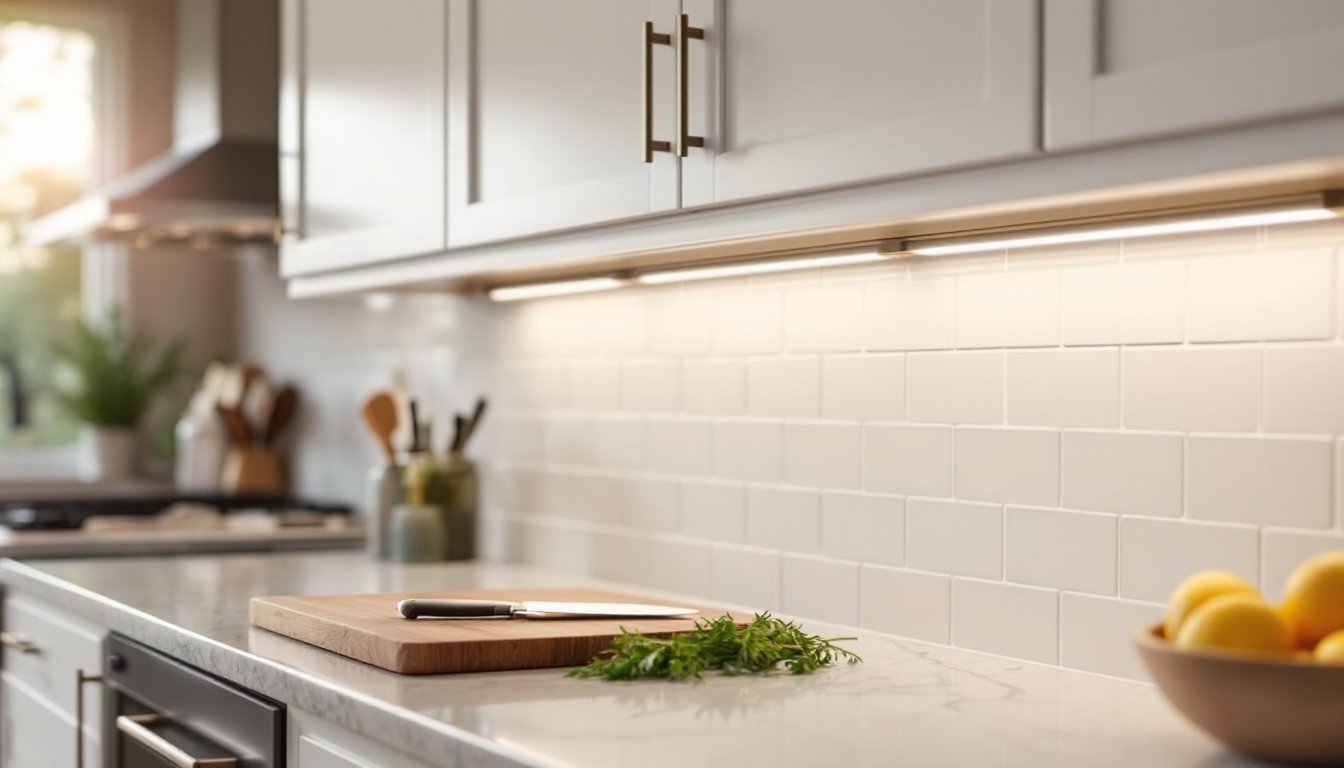
Flip on your kitchen lights and you’ve got one setting: full blast. But when you’re grabbing a midnight snack or setting the mood for dinner, that overhead glare feels all wrong. Dimmable under cabinet lighting solves this by giving you control, bright task lighting for chopping vegetables, soft ambiance for entertaining, and everything in between. It’s one of those upgrades that immediately makes a kitchen feel more expensive and functional. This guide walks through choosing the right fixtures, understanding dimmer compatibility, and installing them yourself without calling an electrician (in most cases).
Table of Contents
ToggleKey Takeaways
- Dimmable under cabinet lighting provides flexible brightness control for task lighting during food prep and soft ambiance for entertaining, while reducing eye strain and adding layered lighting to your kitchen design.
- Linear bar lights offer the best balance of performance and ease for most kitchens, delivering uniform illumination and smooth dimming compared to LED strips and puck lights.
- Quality dimmable under cabinet lighting should dim down to 5–10% without flickering, include a CRI above 90 for accurate color rendering, and deliver 250–400 lumens per linear foot for effective task lighting.
- Plug-in linear bar lights with LED-compatible dimmers are the most DIY-friendly option, requiring proper mounting 2–4 inches from the cabinet front edge and tested compatibility between fixture and dimmer before final installation.
- Avoid common mistakes like skipping the level, mounting fixtures too far back, mixing brands, ignoring power draw specifications, and failing to test dimming performance before securing multiple fixtures in place.
Why Dimmable Under Cabinet Lighting Transforms Your Kitchen
Standard under cabinet lights have one job: illuminate the countertop. Dimmable versions do that and let you adjust brightness to match what you’re doing. When you’re prepping food, crank them up to eliminate shadows on your cutting board. When you’re done cooking and just want a warm glow while the dishwasher runs, dial them down to 20%.
This flexibility also reduces eye strain. Staring at full-brightness LEDs while you’re scrolling through a recipe on your phone creates harsh contrast. Dimming the lights balances the ambient light in the room, making the space more comfortable.
From a design standpoint, dimmable fixtures give you layered lighting, a hallmark of well-planned kitchens. You’re not stuck choosing between “all on” and “all off.” You can use under cabinet lights as accent lighting in the evening, showcasing backsplash tile or open shelving without the overhead cans blazing. For resale value, it’s a subtle feature that buyers notice during showings, especially in kitchens with modern finishes.
Types of Dimmable Under Cabinet Lights: Finding Your Best Match
Not all under cabinet fixtures dim the same way, or at all. Here’s how the three main types compare.
LED Strip Lights vs. Puck Lights vs. Linear Bar Lights
LED strip lights are flexible ribbons with adhesive backing, typically sold in 16-foot reels you cut to length. They’re the cheapest option (around $15–$40 per reel) and work well for curves or non-standard cabinet runs. The downside: many budget strips dim poorly, flickering below 30% brightness or shifting color temperature as you dim. Look for strips rated “flicker-free dimming” and check if they require a separate LED-compatible driver.
Puck lights are small, circular fixtures spaced every 12–18 inches along the cabinet. They create pools of light with visible gaps between each puck, fine for shorter cabinet runs, but longer counters can look spotty. Dimmable puck lights (usually $10–$25 each) often run on low-voltage systems (12V), which means you’ll need a transformer and compatible dimmer. They’re easier to install than hardwired fixtures but harder to get even illumination.
Linear bar lights (also called light bars or strip fixtures) are rigid aluminum housings with integrated LEDs. They range from 12 to 48 inches long and link together for seamless coverage. These deliver the most uniform light and the smoothest dimming performance, especially models from manufacturers like GE, Lithonia, or Kichler. Expect to pay $25–$70 per bar. Many are plug-in with a low-profile cord, making them DIY-friendly without electrical work. Hardwired versions require a junction box and basic wiring skills.
For most kitchens, linear bars offer the best balance of performance and ease. Strips work if you’re on a tight budget and your cabinets have quirky dimensions. Skip pucks unless you’re lighting a small wet bar or island with short cabinet spans.
Key Features to Look for When Buying Dimmable Under Cabinet Lighting
Not every fixture labeled “dimmable” dims well. Here’s what separates frustrating flicker-fests from smooth, reliable performance.
Dimming range: Quality fixtures dim down to 5–10% without flickering or dropping out. Cheaper models might only dim to 40%, which isn’t much better than just turning them off. Check product specs or reviews, if it’s not listed, assume it won’t dim smoothly.
Color temperature: Measured in Kelvin (K), this affects the light’s warmth. 3000K gives a warm white similar to incandescent bulbs, ideal for kitchens where you want cozy ambiance. 4000K is neutral white, good for task lighting but a bit clinical for evening use. Many smart home systems now include tunable white LEDs that let you shift between 2700K and 5000K, though they cost more.
CRI (Color Rendering Index): This measures how accurately colors appear under the light. Anything above 90 CRI is excellent, your red bell peppers and green herbs will look true to life. Below 80 CRI, colors look washed out. This matters more than you’d think when you’re cooking.
Wattage and lumens: Under cabinet lights don’t need to be crazy bright. For task lighting, aim for 250–400 lumens per linear foot of cabinet. A typical 24-inch bar light uses 5–10 watts and puts out 300–500 lumens. More isn’t always better, too much light creates glare off glossy countertops.
Linkable design: If you have more than one cabinet section, buy fixtures that connect end-to-end with jumper cables. This avoids multiple cords snaking to outlets and makes dimming sync across all lights. Hardwired systems link with 18-gauge low-voltage wire: plug-in systems use proprietary connectors.
How to Install Dimmable Under Cabinet Lighting (DIY Step-by-Step)
This covers plug-in linear bar lights, the most common DIY install. Hardwired systems follow similar mounting steps but require running cable to a junction box (and possibly a permit, check your local building department).
Tools and materials you’ll need:
- Dimmable under cabinet light bars (measure your cabinets first)
- Dimmer switch or plug-in dimmer module
- Screwdriver or drill with bits
- Wire connectors (if hardwiring)
- Cable clips or adhesive cord channels
- Level
- Safety glasses
Step-by-step installation:
-
Turn off power at the breaker if you’re installing near existing outlets or hardwiring. For plug-in systems, just unplug anything nearby.
-
Measure and mark placement. Position lights toward the front of the cabinet, about 2–4 inches from the front edge. This keeps the light source hidden from view but maximizes countertop coverage. Use a level to mark screw holes, crooked lights are immediately obvious.
-
Mount the fixtures. Most bars have keyhole slots or twist-lock clips. Pre-drill pilot holes if screwing into solid wood: if your cabinet bottoms are particleboard or MDF, be careful not to overtighten and strip the material. Some fixtures use adhesive tape, clean the surface with rubbing alcohol first for better stick.
-
Link multiple fixtures using the included jumper cables. Route cables along the back edge of the cabinet and secure with adhesive clips so they’re not dangling.
-
Run the power cord to an outlet. If the cord is visible, use a low-profile cord channel (available at hardware stores for $5–$10) to tuck it along the cabinet side or backsplash edge. Avoid running cords across the backsplash where they’ll be in plain sight.
-
Install your dimmer (see next section). Plug in the lights and test the full dimming range before buttoning everything up.
-
Adjust and secure. Once you confirm everything works, double-check that fixtures are level and all cables are tucked away. Step back and look from normal viewing angles, you shouldn’t see the LED strip itself, just the light it casts.
Hardwired install notes: You’ll need to connect the fixture’s lead wires to 120V house wiring inside a junction box (typically under the cabinet or inside the cabinet above). Match black to black (hot), white to white (neutral), and green or bare copper to ground. Use wire nuts rated for the wire gauge. If you’re not comfortable working with live circuits, hire a licensed electrician. Most jurisdictions require a permit for new hardwired lighting circuits.
Choosing the Right Dimmer Switch for Your Under Cabinet Lights
Here’s where DIYers often trip up: not all dimmers work with all LEDs. Traditional incandescent dimmers use a technology called TRIAC phase dimming, which can cause LEDs to flicker, buzz, or refuse to dim below 50%.
For plug-in systems: Use a plug-in dimmer module (also called an inline dimmer). These sit between the fixture plug and the wall outlet and are specifically designed for LED loads. Lutron makes the Credenza model ($25–$35) that handles most LED under cabinet lights without issues. Some fixtures come with a remote control dimmer, convenient but easy to lose.
For hardwired systems: Install a wall-mounted LED-compatible dimmer switch in place of your existing switch. Look for dimmers labeled “LED/CFL” or “ELV” (electronic low voltage). Lutron’s Diva and Maestro lines are reliable: Leviton and Eaton also make good options. Expect to pay $15–$50 depending on features.
Check the load rating: Dimmers list a minimum and maximum wattage. Most LED under cabinet setups draw 20–60 watts total, which can be below the minimum load of some dimmers (often 25W). If your total load is too low, the dimmer won’t work correctly. Solution: buy a dimmer rated for low-wattage LED loads (some go as low as 1W minimum).
Smart dimmer options: If you want voice control or app-based scheduling, smart dimmers from Lutron Caseta ($50–$80) or Leviton Decora Smart integrate with Alexa, Google Assistant, and HomeKit. They require a neutral wire in the switch box, which older homes may not have.
Whatever dimmer you choose, test it with your specific lights before you install a dozen fixtures. Buy one light and one dimmer, set them up, and run through the full dimming range. If it flickers or won’t dim smoothly, try a different dimmer model. Manufacturers often publish compatibility lists, check those before buying.
Common Installation Mistakes to Avoid
Even straightforward installs can go sideways. Here’s what to watch out for.
Skipping the level: Crooked light bars are glaringly obvious, especially on long cabinet runs. Always use a level when marking holes, even if your cabinets look square. They probably aren’t.
Mounting too far back: If you tuck the fixture against the cabinet back wall, the cabinet’s front edge casts a shadow on the counter. Position the light 2–4 inches from the front for even coverage. Testing with inside cabinet lighting can also help you visualize different placement effects.
Mixing fixture types or brands: Linking different models together often results in mismatched color temperatures or uneven dimming. Stick with one product line for a uniform look.
Ignoring power draw: Overloading a dimmer causes it to overheat and fail. Add up the wattage of all your fixtures and make sure it’s within the dimmer’s rated capacity (and above its minimum load).
Using the wrong wire gauge: If you’re running low-voltage wire between fixtures, don’t use speaker wire or lamp cord. Use the gauge specified by the manufacturer (usually 18 AWG for low-voltage LED systems). Undersized wire causes voltage drop, which dims the lights and shortens LED lifespan.
Forgetting about heat: LEDs run cool, but their drivers (the little power supply box) can get warm. Don’t bury drivers inside insulation or trap them against combustible surfaces. Leave at least an inch of clearance for ventilation.
Not testing before finishing: Don’t mount, link, and secure six fixtures and then test the dimmer. Confirm everything works after the first fixture so you’re not troubleshooting a whole system later. Independent testing labs and reviews, like those found on best under-cabinet lighting roundups, can also guide you toward proven models.
PPE reminder: Wear safety glasses when drilling overhead into cabinet bottoms. Wood shavings and metal shards fall straight into your eyes. If you’re cutting metal channels or housings, use work gloves to avoid sharp edges. For hardwired installs, confirm power is off with a non-contact voltage tester before touching any wires.
Getting dimmable under cabinet lighting right isn’t complicated, but it does require matching compatible components and taking a few extra minutes to mount fixtures properly. Done correctly, you’ll have adjustable, shadow-free task lighting that makes your kitchen more functional and a lot more pleasant to spend time in. And when guests ask how you got that clean, high-end look, you can tell them you did it yourself on a Saturday afternoon.